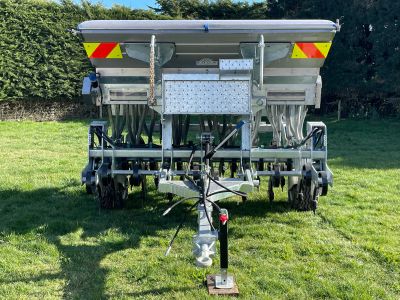
When comparing seed drills, terms such as air seeder, box drill, gravity drill, disc drill, tyne drill and S-tine drill are often used interchangeably.
Understanding that distinction makes comparing seed drills much easier — and helps explain why two machines designed to establish the same crop can work very differently in the paddock.
When looking at a seed drill, there are really two systems to consider:
The two shouldn't be confused.
An air seeder, for example, can use either disc or tyne openers.
Similarly, two tyne drills can use very different seed delivery systems.
Let's look at each separately.
An air seeder uses a pneumatic system to transport seed.
Seed is metered from a central hopper or tank before airflow carries it through a distribution system and along hoses to the individual outlets.
This approach offers some genuine advantages.
A central metering cassette can be compact and accessible, with relatively few metering components to inspect or maintain.
Central tanks can also make loading straightforward, particularly when handling large quantities of seed or fertiliser. Larger cart-style systems can offer substantial capacity and allow wide sowing bars to fold independently for transport.
For large farms covering significant areas within tight sowing windows, those characteristics can be particularly useful.
Pneumatic delivery can also maintain seed movement when operating on slopes and side angles, where seed movement within a poorly baffled gravity hopper may otherwise affect delivery.
Multiple-tank air systems can provide additional flexibility by allowing different products to be metered independently.
There is a reason air seeders have become an important part of modern farming systems.
A conventional box drill takes a different approach.
Instead of transporting seed from a central meter using airflow, seed sits in a full-width hopper positioned above the drilling units.
Individual metering units distribute seed to the rows below, where it travels a relatively short distance to the opener.
There is no pneumatic delivery system required.
That makes the basic principle relatively simple:
This simplicity is one of the longstanding attractions of the box drill.
There is no fan or long pneumatic delivery system, and the individual outlets are readily accessible.
Depending on the machine and application, that can mean simpler servicing, fewer systems to monitor and lower tractor hydraulic requirements.
Large air carts can carry substantial volumes of seed and fertiliser.
For large-scale operations, fewer filling stops can be a significant advantage.
Their central hopper design also suits bulk filling systems such as augers.
A traditional box drill spreads its hopper across the working width of the machine. Capacity may therefore be lower than a large air cart, although the hopper can sit considerably lower.
That can make loading possible with more conventional farm equipment.
The Boon 3-metre drill, for example, has been designed to carry more than a tonne while retaining a relatively accessible loading height.
A central air-seeder tank can be convenient when changing varieties or seed types: rather than working along a full-width box, the operator has one central hopper to empty and clean.
A box drill requires the full hopper and its individual metering compartments to be checked and cleaned.
The trade-off is visibility.
With a box drill, the operator can physically inspect seed across the width of the hopper and access individual metering components directly.
How seed travels from the meter to the ground is another difference worth considering.
An air seeder relies on airflow to transport seed through its delivery system, which means airflow and fan speed need to be correctly set for the crop, machine and operating conditions.
Research published by Manitoba Pulse & Soybean Growers looking at field peas found that seed moisture was a more significant factor in seed damage than variations in fan speed. In the study, peas with moisture below recommended levels experienced significantly lower germination and vigour, while the different fan speeds tested did not significantly affect germination, vigour or seed-coat damage.
Other research published by Manitoba Pulse & Soybean Growers examining soybeans, wheat and canola has also demonstrated that the effects can vary depending on seed type, seed moisture, machine configuration and operating conditions.
The practical takeaway isn't that pneumatic delivery inherently damages seed. It's that an air-delivery system introduces additional operating variables — including airflow — that need to be correctly managed, particularly when handling more damage-sensitive seed.
A gravity-fed box drill takes airflow out of that equation. Seed is mechanically metered before travelling a relatively short distance to the opener under gravity, with no fan velocity involved.
It's a different approach to seed handling, and another factor worth considering when comparing drilling systems.
An air seeder introduces components associated with pneumatic delivery, including a fan, hoses and distribution system.
Modern systems can incorporate monitoring technology such as blockage detection and in-cab rate control to help operators keep track of what's happening through the system.
A gravity-fed box drill eliminates the pneumatic side of the system.
Seed travels through much shorter delivery paths and there is no fan required to move it.
Which approach is preferable depends partly on what the operator values: the centralised delivery and monitoring capability of an air system, or the mechanical simplicity and accessibility of gravity delivery.
This is an interesting comparison because both systems can offer advantages — but for different reasons.
An air seeder's pneumatic delivery helps keep seed moving through the delivery system regardless of the machine's operating angle.
With a gravity drill, hopper design becomes particularly important.
Without effective baffling, seed can move within a full-width hopper when operating across a slope, potentially affecting how seed is presented to individual meters.
A properly baffled hopper helps restrict this movement.
The Boon Drill uses tent baffles between each drop, helping retain seed within its intended section of the hopper when working across changing terrain.
There is another consideration: weight distribution.
A full-width hopper distributes its load across the width of the drill, whereas an air seeder commonly concentrates more of its seed and fertiliser load within central tanks.
These are different engineering approaches, and machine stability will ultimately depend on the complete machine design, load, terrain and operating conditions.
Gravity delivery also creates some interesting possibilities because seed is available individually across the width of the hopper.
Boon Agriculture has developed a patent-pending distribution tray that uses this characteristic to divide material from the same hopper between two applications.
A selected proportion can be directed through the drill while another proportion is broadcast.
For example, an operator could drill grass while broadcasting clover during the same pass, with the system configured to provide the required split.
This is an application of the gravity-fed design rather than an indication that every farming system requires this capability.
For farmers wanting to establish different seed types in different ways during a single pass, however, it provides another option to consider.
So far we've only discussed how seed travels through the machine.
The next question is arguably just as important:
What happens when the drill meets the ground?
This is where the distinction between disc, coil tyne and S-tine systems becomes important.
A disc opener uses a rotating steel disc to cut through the soil and create an opening for seed placement.
This generally creates relatively little soil disturbance.
Disc systems can be particularly useful where maintaining surface residue and minimising soil movement are priorities.
Their ability to cut through residue is also one reason they're commonly associated with direct-drilling systems.
Are your customers raving about you on social media? Share their great stories to help turn potential customers into loyal ones.
Running a holiday sale or weekly special? Definitely promote it here to get customers excited about getting a sweet deal.
Have you opened a new location, redesigned your shop, or added a new product or service? Don't keep it to yourself, let folks know.
Customers have questions, you have answers. Display the most frequently asked questions, so everybody benefits.
Not every S-tine system is identical.
Strength, geometry, spacing and clearance all influence how the drill behaves.
Crop residue and trash need sufficient room to move through the machine rather than accumulating around the ground-engaging components.
Boon's S-tine has been developed with strength and trash clearance in mind while retaining the flexing and vibrating characteristics associated with the S-tine principle.
This is another area where it's useful to separate seed delivery from ground engagement.
An air seeder uses airflow to transport seed through the machine, which can provide reliable seed movement through its delivery system.
But airflow doesn't determine whether crop residue physically passes between the drill's ground-engaging components.
That depends on factors such as:
So when evaluating claims about a drill's ability to “handle trash”, ask which part of the system is actually being discussed.
Rather than asking whether an air seeder or box drill is better, it can be more useful to ask what matters most to your operation.
I
f you're covering very large areas and prioritise capacity, wide working widths, centralised metering and bulk filling, an air-seeder system may have clear advantages.
If you value mechanical simplicity, individual row metering, accessible components, lower loading height and gravity delivery, a box drill may deserve a closer look.
Then consider the ground-engaging system separately.
Do you want minimal soil disturbance?
Do you want the opener to create some tilth around the seed row?
How much crop residue do you normally encounter?
Are you drilling into cultivated ground or direct drilling?
How variable are your soils?
What are your paddock contours like?
And how much complexity do you actually want to maintain?

Air seeders and box drills represent two different approaches to seed delivery.
Air seeders use pneumatic delivery, offering advantages such as centralised metering, substantial capacity and the ability to service wide working widths.
Box drills use individual gravity-fed delivery, offering a mechanically straightforward system with direct access to individual rows and short seed-delivery paths.
Then there's a separate decision to make.
How do you want to engage with the soil?
Each changes what happens between the machine, soil and seed.
Understanding those two decisions separately — seed delivery and ground engagement — is a much better starting point for choosing a drill that suits the way you actually farm.
We use cookies to analyze website traffic and optimize your website experience. By accepting our use of cookies, your data will be aggregated with all other user data.